Resources
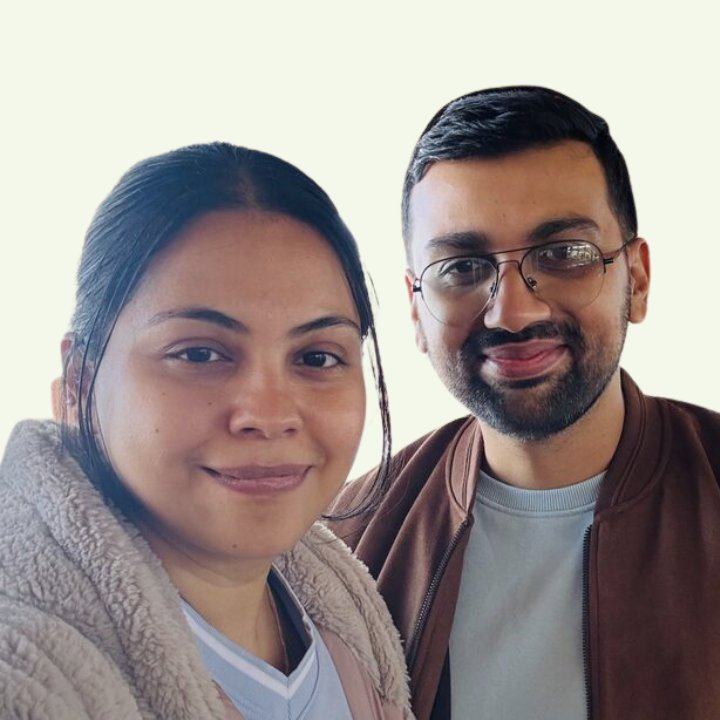
Connect with Abhijith HK and Vidhya Abhijith
Episode Transcript
Lisa: Okay, welcome both of you to the Leadermorphosis podcast. Thank you so much for joining all the way from India.
Abhijith: Thanks, Lisa, for having us.
Vidhya: Thanks, Lisa.
Lisa: So I was thinking maybe we could start by you sharing something about Codewave’s origin story, because I think it’s quite unusual for people to start a company that from the beginning is quite flat, quite democratic. So can you say something about what gave you the inspiration to do that?
Abhijith: Okay, the big why. So we’ve been running this for almost twelve years, but many of the people whom we’ve interacted with don’t know that we were actually accidental entrepreneurs. We come from a middle-class background, and really, in our family, no one has been an entrepreneur in the past. So this was not a journey that we really thought we were going to be taking. It just happened along the way. In fact, twelve years back, I was this geeky techie playing my PS3 and being an introvert. I would have really laughed off if someone had told me I’d be running a company of about 200 people, especially with zero HRs. Yeah, but here we are.
Prior to Codewave, Vidhya and I knew each other for almost three years. We worked in this travel-based startup, and both of us joined almost at the same time. That company, when we joined, was a team of about forty, fifty people. I come from a tech background, and Vidhya comes from a product background. Luckily, we got an opportunity to work with each other for almost all the three years.
Things were great when it was a small startup. I had access to the vision directly. I could interact with the CEO, CTO. I could interact with the end customers, or if I was building internal labs, with the end users—how they were using it, how whatever I was doing was really impacting them. I had access to all of that, and frankly, it was super empowering. It was addictive as well, I would say.
The company grew over the period of three years from a team of 50 to a team of 200, 250. There were further rounds, and naturally, the only way people—not just them, but in general in India—knew how to scale was through hierarchy. So in some time there was a manager, and in a few more months there was a manager’s manager, and so all of that came in. In no time, there were also the bad aspects of hierarchy that started creeping in: red tape, people showing my work as theirs, the politics, the backbiting, all of that.
Frankly, it was more like a turnoff, especially when I had seen the other side, the good side of it, where you can really be truly impactful. This side was just a turnoff. It was very clear that this is not how I want to spend my time further beyond. I had conversations with the leadership team. They put their hands up saying, “Hey, I don’t know how else to do this. Everyone just does this.”
So I had basically two options. One was to quit that company and find another job. But more or less—I mean, I have friends everywhere—more or less, the same thing happens across India or even globally. Even the so-called flat orgs are really not flat. There are hierarchies in mind. Although they’re sitting all in one floor, there are different kinds of egos and hierarchies that are in play.
The second thing was to start something on our own. Frankly, at that time, both Vidhya and I were having these discussions, and we had this vague idea of how an org could run—more like a social network, thriving on autonomy, authenticity of people, and even creativity, bringing your fullest self and being impactful. That’s the real why. Vidhya, you want to add anything?
Vidhya: Yeah, just a couple of experiences—my experiences from which I learned what not to do as an organization. One experience was when I used to post in a group chat within the organization. It was just knowledge sharing or general sharing of ideas. Once I got called by my boss and literally warned for talking too much in the group chat. According to them, they wanted to use the group chat only for anniversaries and birthdays, not to socialize ideas. So I felt the employee voice was a bit controlled.
Also, coming from a design background, I like being in a space where you have that freedom to express yourself and not be judged for it. So I kind of wanted to create a place where these things don’t happen, where we are not boxing people into titles and JDs, where these identity narratives start coming—“I’m a designer, so I can’t do this. I’m a developer, so I can’t do this.” These limiting narratives don’t really help. But like Abhijith said, if you create a space where people’s creativity and ingenuity can be unleashed, I think then the work becomes very disruptive. The outcomes become very creative for our customers. So that’s what we wanted to tap into—tap into the ingenuity and greatness of people.
Lisa: Yeah, thanks for sharing that. I relate so much. I think the three of us would have been friends if we’d worked together. I think we share a spirit of wanting to have a voice and shape things. I remember I was similarly—I wasn’t trying to be a rebellious employee actually, but it was perceived as sort of rebellious, like, “Okay, you know, get back in your box please.”
So I really love that you had this impulse to create an organization that wouldn’t control employee voice and would be more involving from the beginning. And I found it interesting that you did this intuitively, because very often I have guests on the podcast who, you know, they’ve read Reinventing Organizations by Frederic Laloux or they came across some example out there that then inspired them. Whereas you went more from intuition—intuitively, we want to create something. We know what we don’t want to create, and we have an idea of what we would like to create. And it wasn’t until a few years after you’d founded Codewave that someone then pointed out to you, “Oh, have you heard of Semco, for example?” So I thought that was kind of interesting.
Abhijith: Yeah, absolutely. In fact, that was relieving. This was, I think, 2017 or 2018. That’s when we heard about Semco. And frankly, when we heard that there was someone who scaled, it was a big relief because, frankly, until then, whomever we met, they always literally laughed at us saying, “Hey, you guys are cute. Okay, you’re 20 or 30 or 40. Alright. But you can’t scale to a 100-member company. Can’t scale to 200, 500-member company.”
When a lot of people always say no, we didn’t lose hope. We had each other, thank God. And we’ve always been questioning “how else” and “why not this.” That’s been the nature of how we’ve built the org itself. In fact, design thinking is not just for the customers—it’s how we built the org itself. So that was very intuitively coming to us. It was not easy, but we were very clear about what we don’t want to be because we’ve seen the other side and seen the things that it brings in. There are different ways to grow, and we were very clear that’s not the way we would want to grow as an org.
Transparency and trust—again, trust is a thing that happens. You can’t expect trust. But when you do things with common sense, bring people together, be transparent about why you’re doing what you’re doing, be transparent about how much money you’re making, or anything that is happening—naturally, trust is the next step. It automatically happens.
We’ve been very keenly observing what’s working and what’s not working while we’ve been experimenting. It’s been a continuous experiment for the last twelve years, and we’ve had a lot of failures as well. But one thing that’s been guiding us is that keen listening—listening on the ground to what’s really working, being open to criticism with each other or with people. Those were some of the guiding lights.
Lisa: Yeah. I thought maybe we could talk about scaling then, because I think that’s, as you say, a lot of people are skeptical about whether you can scale this. Like, “Oh, sure, it works for twenty, thirty people.” You’ve managed to scale to 200 and counting. So what have you learned along the way, and how has the organization evolved? You’ve evolved some really interesting practices as kind of alternatives to some of the usual hierarchical management practices. So could you say something about how you’ve been scaling Codewave?
Abhijith: Yeah. Again, like I said, I think we started with common sense. We did not know the word “self-management” at all when we started. We were just keenly listening, observing, and then building on top. And of course, there’s a validation of why you exist. So it is not just the cultural part of it, but also the business side of things.
We were into design-led engineering. Basically, India was being looked at as this software offshoring giant, and most of the thinking was happening in the West. We wanted to change that. We wanted to bring the thinking back. And naturally, the culture of what we had was more empowering. We wanted to make sure that people are their natural selves, and we strongly believe that influence can happen from anywhere. It doesn’t mean that the most experienced person in the room will have the topmost idea—that’s a wrong assumption to make. We’ve seen the opposite happen. Interns who just joined in had brilliant ideas. So I think it’s just a matter of creating that platform, and we were very clear about building that. Vidhya, you want to add anything to this?
Vidhya: Yeah, sure. So the organization itself was designed with two principles. One was transparency. We’d be radically transparent about our financials—who’s our customer, where the money is coming from, where it’s going, how much money the company is making, and how much profit is shared with people. So transparency was very core to how we were designing our org.
The second one was distributed decision-making. We didn’t want this central unit to decide everything for everybody. Rather, we wanted to encourage local decision-making. We were trying to organize ourselves into groups that can serve the customer and which can be nimble, transparent, and locally empowered. They’re all acting autonomously without external instructions or waiting a lot for approval.
Initially, we were just looking like a social network. You can imagine a network of connected human beings, just like a social network, when we were small. As we grew slowly bigger, like 50 to 80, imagine different circles of projects—an organization of 80 people organizing themselves around projects, each of them owning their project success, running independently like a unit.
From 80 to 200, I think that was a journey where we started asking, “How can we create a company of companies rather than organizing ourselves around customer projects? Can we make it even more entrepreneurial for people?” So then we started organizing ourselves into Fractas, which is basically inspired by fractals in nature. This Fracta is nothing but a mini startup, a startup within our organization. It’s a cross-functional group of people, and it runs its own profit and losses, does its own projects and initiatives.
If you look at our org now, it’s a bunch of Fractas running autonomously, and all of these Fractas come together, contribute two or three volunteers to govern the org itself. That’s like a volunteer-formed initiative group that runs organizational KPIs, and they also have Fracta KPIs that they govern. You can visualize a bunch of circles that are self-formed to run their own units and also contribute to the org’s success.
Abhijith: But conceptually, it’s remained pretty much the same from day one. These are moving groups of people based on a need. They come together, make things happen, break things, and then the next six months, one year, they work together, take a lot of decisions locally, work with the customers directly. A lot of information is fully transparent for them to take these decisions. That continues to be there from literally day one, and it continues to be there.
It’s just that with the Fracta structure, as we scale to 150, we had this question of how the org structure should look. Should we have a 150-person unit and then multiply it, like typically how others have? Or is there an alternate way of organizing yourself where it can be very differently done? So again, these are experiments that are ongoing, and we’ve been able to find good amounts of success so far.
Lisa: I want to talk about a culture of development and feedback, because I know that’s something that you’ve focused on as you’ve scaled your culture. So I wonder if you could tell us a bit about your peer-based replacement of what’s traditionally known as a performance management process, which you call Peerly. Could you tell us a bit about that?
Vidhya: Yeah. So traditionally in a hierarchical organization, there is a manager sitting across the table having an awkward conversation, because they have no context into what the individual has done through the year. Neither does the individual see much value in that conversation. And probably it’s just a one-off conversation, and after that nothing happens.
What we thought was, can we tap into peer power? And if we can listen to customers sitting 2,000 miles far away from us, why can’t we listen to people just around us in our immediate surroundings—people whom we spend most of our work time with? Why don’t we ask feedback from them? That’s something we questioned.
The second thing is, how do we define performance? Is it going to be only output or time? Or should it be more human? Should it be around, “Can I trust this person? Can I count on this person when things go south? Does this person play as a team? Do they listen? Do they empathize?” So some of these parameters as well we included into performance parameters. I would say three out of five of our performance parameters are more human. They are subjective.
These are the two things that designed Peerly. Peerly is basically a peer-to-peer feedback system to eliminate bias. How it works is every six months, a fresh panel is elected by people—who they want as a Peerly panel. This panel is then mapped a few individuals, like three to four individuals, for whom they collect feedback.
The panel collects feedback from customers, peers, team members, and partners, and curates that feedback. They let the individual digest and reflect on the feedback. They could even accept, agree, disagree, or decline feedback that they don’t find relevant or constructive. So it’s a very constructive conversation between the panelist and the individual.
Once this is done, the panelist maps their performance in one of the brackets: A, B, C, D, or E. This panel also decides on the hike budgets for the season. Based on the company’s financial health, they come up with what could be a good hike budget for the season, and even how the hike should be distributed among the brackets—the performance brackets A, B, C, D, E. Should we incentivize only the high performers, or should we make the hikes more even across the company and celebrate everyone’s contributions? This is all decided by the Peerly panel itself.
Lisa: And just to interrupt—so when you say “hike,” that’s what you’re describing as a period of time where you might distribute money in terms of people getting compensation?
Vidhya: Appraisal cycles, yes.
Lisa: Nice.
Abhijith: Again, a lot of this is coming from first-principles thinking. How might we make things more democratic? And why democracies? How can we add more people into the decision-making or make them learn the process of this? And how might we find the next-gen leaders? Because as it scales, it cannot be Abhijith and Vidhya identifying potential. People are coming from different places, growing at their own rate. It’s not ladder-based growth anymore.
We are living in an information age where information is at people’s fingertips. No one can define, “Hey, you have to grow in the next two years this way.” Everyone’s growth journey is very unique, and we have to be open about that. A lot of that first-principles thinking led to probably the 555th version of Peerly the way it is. We’ve also had a lot of failures in the past. But that is the current working model, which again might change slightly with the Fracta things coming into the picture. It’s becoming a little more bulky right now. So we’re already in discussion on how we might do that in a more optimized way—how we can decentralize further while keeping the intent and the democratic way of doing things.
Lisa: And when I was learning a little bit about Peerly, I understand also that after the panelists have collected feedback, I then also get support, don’t I, from someone? It’s not like, as you said, a traditional performance management where it’s a one-off and then I have to wait until next year maybe for my next performance appraisal. It’s more like peer-to-peer coaching. Can you say something about what support happens after that feedback is shared?
Vidhya: Yeah. So right now what happens is after the discussion, after the one-on-one with the panelists, the individual gets to choose an accountability partner that they would like to grow with. So they could choose a peer and have further conversations with them on setting the goals for the next season.
These goals that people set for themselves are set by themselves. It is something that they want to do. So the growth is self-paced, and the direction is something that they choose. They can change roles, they can change projects, they can move around, pick up different roles they want to do. They’re free to do that at Codewave. They’re not limited by titles or JDs.
And again, it’s a mix of both personal and professional goals that people have. People have aspirations like “I want to build a home in the next three years” or “I want to buy a BMW.” There are different kinds of aspirations that people have. People are free to set those as goals. Let’s say somebody wants to become a public speaker, or somebody wants to get married. There’s space to set your own personal and professional goals so the journey is fulfilling for you.
Abhijith: And these accountability partners or growth coaches—they basically bring in information. If they don’t have information on how they might help this person, for example, someone wants to invest in or learn how to do stock trading and earn secondary money along with the regular salary—so they can always find someone who can help them with it. Together, they’re making the main person succeed both professionally and personally. That’s what we’re trying to do.
Lisa: I imagine, given that feedback then becomes quite an important part of your culture, I was reading somewhere that at some point you realized that your culture had ended up in the ruinous empathy quadrant of the Radical Candor feedback framework, for those who are familiar with it. I find that’s quite common actually in many organizations, but especially decentralized, self-managing organizations—that we care about each other, things like equality are important, and the shadow side of that is that we can all become extremely polite and nice and not feel confident giving each other more difficult feedback, which is really needed for us to grow.
So I’m curious to hear about what you did when you discovered that you were falling into this ruinous empathy trap, and how have you found ways to move more towards a Radical Candor feedback culture?
Abhijith: Yeah. So again, the reason why we fell into that ruinous empathy was also that the first three years we were an organically formed team. People referred people, and again, we had siblings, we had family members, spouses, we had friends, childhood friends coming in. It is a close-knit community. In fact, we were calling ourselves “family” as well—the Codewave family. So we fell into that trap at that time.
Now, of course, we always call ourselves “community.” With family, the thing is you have unlimited, endless tolerance. And in a company, you cannot afford to do that. This was around 2015 when we were tested for the first time. Until then, things were really good. We were going up—the revenues were growing 100% year on year. Things were good. In fact, we had three hikes or three performance cycles every year. So we were distributing money continuously as well.
Suddenly, there were some governmental shifts that happened. We were a lot dependent on the Indian market at that point in time. Typically, when there are these big changes, the investors pull back. They put a hold for the next six months, one year. In fact, there were two such decisions. Six months down, there was some other big change that happened, because of which the demand for one of our roles—I think it was mobile development at that point in time—was becoming low. So we had surplus supply.
And as family, what you think is, “Hey, we’ve had a great run in the last three years. This time, let’s hold on because we’ve not made any profit. Instead of letting go of people because for one year we did not have work, let’s say no to hikes. Can we do that?” We thought it would be okay because we’re a family. That didn’t go too well with most people. I believe scarcity brings clarity. We saw some of the people who moved out of Codewave who’d been there since day one, some of the high performers.
The thing was, because of the way we were formed as a unit, giving critical feedback to each other was difficult. “This guy was someone whom I know for ten years. He was my childhood buddy. How can I give critical feedback?” It’s very difficult. And other times, as founders, we think, “This is too obvious. Do I even need to tell someone this?” You’re burning out, saying, “How can this person not see this?”
These things were happening to us and people around. The outcome was we were slowly and steadily becoming a substandard company from a quality point of view. The growth was slowing down, and complacency was increasing. So this was a time where we knew there was an intervention that needed to be done.
Thankfully, we learned about Radical Candor. We realized where we stand. I did a workshop internally. We brought in all the people. Everyone said we care too much, and this is where we are. We’re not challenging each other where we can go. We have huge amounts of potential, but that’s just not working. Everyone agreed that this is what it is. Then we came up with our own structure on how we can make that happen—how we can give feedback.
When we brought in everyone, it was no longer a bad thing to give feedback. The reason why you’re giving feedback one-on-one is because you care for that person. You want them to grow. It’s not because you’re going to escalate and cut down on their appraisal cycle. It needs to be given at a point in time where you can actually act upon it.
More often than not, what happens is people wait for the D-day at the end. They bring in something, and then the person getting the feedback is super frustrated. “Hey, this happened six months ago. Why did you not tell me? I’m continuing to do this.” We hear this so often. Thanks to the coaching internally, we had the L1, L2, L3—different ways we can give feedback, how we can give feedback. We coached, we did a lot of role-playing. Now, in fact, for anyone coming in as part of induction, that’s part and parcel.
How do we know it’s working? When we get those feedbacks ourselves from anyone and everyone. That tells you this is a place where people are not afraid to give feedback, and growth is a natural next step when this happens.
Vidhya: In my experience, I think as leaders we had to learn to be explicit. We had to start communicating explicitly: “This is what we are expecting, and this is not something that we are expecting.” Because as young founders, we ourselves were not comfortable being explicit. When we were small, we used to just assume, “I think they get it.” A lot of things we assumed were obvious.
I think that’s an upgrade we ourselves had to do before we teach others or coach others on Radical Candor. So that’s how we got out of the ruinous empathy phase—first upgrade ourselves, then do the role-plays, and then come out of it.
Lisa: Yeah, that’s super important. I want to come back to some other lessons you’ve learned as founders as well. But I wanted to pick up on something that you said, Abhi, about induction, because I know that—I mean, I think this is true in any country as well as India—that the way that you’re working is quite unusual. It can sound like utopia on paper, but we know that in practice it’s quite challenging. It requires quite a lot of self-awareness and development. So how do you support people to join Codewave, and how do you induct them into this quite unique culture and way of working?
Vidhya: So maybe I can take this. Firstly, we don’t look at degrees because we know individuals can have a fantastic CV on paper, but what matters is a lot of things other than what’s on paper. So firstly, we don’t just look at degrees.
We hire for entrepreneurial spirit, and we look for self-awareness. Is this person vigilant enough? Are they listening, and are they able to think about solutions? These are a few things we do when hiring itself.
Then once somebody comes into the system, they go through a design thinking workshop. They have to pick up an idea they care about—a problem that they want to solve for society—and go from idea to prototype. This is something they do for the first two weeks when they are in Code Wave, and they do it as a group activity. They get to learn about people, they get to learn about teams, they get to learn a lot of vocabulary that we typically use in the design world. That’s one of the experiences that we create for the new members.
Abhijith: And again, whatever amount of induction that you do, there will be skepticism because this is probably not the first company they’ve joined. Like you said, especially when you talk about the kind of concept that we are talking about, more often than not, people think this is too good to be true. There’s no way something like this is going to happen.
But what we’ve seen is, again, when they go back and see that in action, they see it in and around, and then the belief comes in. In fact, we don’t do induction from day one. We want them to absorb a little bit of what’s really happening and be curious—like, “Why is this happening the way it is happening? This is not the norm. Why are they sharing so much information about the revenues or even what new project is coming in, who the customer is? Everything is literally out there.”
We typically do the induction after three or four weeks so that they’ve absorbed something. They’ve observed, interacted with the culture, and they are probably curious. They’ll be in a better position to digest what we are saying. That’s another thing that we consciously did.
Lisa: I like that. I like induction processes that are kind of like mini fractals of the organizational culture. I like that you give them a design thinking exercise. I know that design thinking has been like a red thread throughout your organization and, in a way, was very influential in you designing the organization—thinking of your employees as users and asking, “Why should it be this way? Could it be another way? What else?” So I really like that as a theme.
Also on the topic of induction, I know that your handbook is kind of open source, which I love. So I was having a look through your handbook, and there was a page that I really loved. I laughed out loud. You have a page called “What is Codewave not good at?” and you share some things about learning edges and things that you’re still figuring out.
I loved that honesty. And I think it also feeds into the idea that when you join Codewave, part of your role is to co-create and evolve ways of doing things. So I wondered, how would you answer that question today? What is Codewave not good at, if you like? Or what are you struggling with or wrestling with?
Abhijith: While I think whatever we talked about still holds true, I think some of the things that we are not good at is telling people how they should grow. It should come from inside, from them. You can coach them, mentor them to help them get where they need to go. But there are a lot of companies who are good at just saying, “This is what you need to be,” or whatever. We are not, because after that, you are the one who has to be behind them. That’s not how we believe growth should be.
People should be passionate about what they want to become and the future self—how they see themselves in the next five years, ten years, how they see their own growth. And again, like I said earlier, we’re in an information age. People can—they are adults, and they’ve taken a lot of decisions on their own before they’ve joined Codewave. They are capable of creating their own path. And then, of course, there is guidance, nurturing—all of that can happen—that we’re good at.
Probably another thing is bringing change through force or fear. Again, there are times where we struggle with bringing change. It takes more time because you need to have a lot of patience to run a self-managed org. Because 80% of the team has to be aligned, and then the moment happens and picks up exponentially. But there are ways where it becomes a lot easier even though there might be misalignment. Through force or fear, most organizations make that happen. But we’ve been very conscious of not doing that. The impact of that is sometimes the change might be slower than anticipated, which we’re okay with. We have the patience to work through that.
Vidhya: Just to add to that point, when people ask us, “Do you want to prioritize strategy to grow 10x or culture?” they always have this strategy-or-culture, culture-or-strategy question. That’s a struggle we have. We cannot compromise culture. So we always say that we’re going to grow consciously, which means we are going to say culture and strategy together.
I would say something we’re not good at is scaling or growing strategically without culture. That’s not something we’re naturally good at.
And to add to Abhijith’s point on helping people grow, our hiring is kind of unconventional. We have people who have run Xerox shops who are doing design now, who are leading design. There are also people who are running a music band and have two careers—pursuing music and also pursuing design. I think people are great at creating life paths themselves. All we’re doing is just nudging and asking questions on what they want to do and how it can help the org.
Lisa: Yeah, I like that. And I suppose that even with a really good induction process, there will be people who perhaps join Codewave—I know we’ve experienced this in my organization, Tuff, as well—who in the end realize, “This isn’t for me because perhaps I want someone to tell me how I should grow.” And that’s okay.
I think in the beginning I was a bit dogmatic, like, “Everyone wants to work in this way.” And now I realize that it’s not for everyone, and that’s okay. If we can support people to discover that, then we might help them to find an organization that does meet their needs. Because it sounds like to work in Codewave, you need to be someone who is quite entrepreneurially minded, somewhat self-aware, and self-sufficient—even though you have some really great peer structures in place.
I think sometimes self-managing organizations try to create something that works for everyone, and I think that’s just unrealistic. It’s better to be honest and support people as quickly as possible to evaluate: Is this for me? Is this a fit or not?
Vidhya: Yeah, and it’s difficult to sustain in the peer environment because instead of a hierarchy where you have one boss, sometimes in a peer environment you might have 17 bosses, 17 peers. It’s kind of difficult to take feedback. It’s up to one’s taste.
Lisa: Yeah. And I guess in a traditional organization, you always have this “second job” of looking good. In a traditional organization, I mainly only need to look good to my manager. If they think I look good, then I can succeed. Whereas here, you’re more exposed in a way because you have multiple peers who are all sort of evaluating you. So it’s harder to escape from getting feedback. And again, it’s not for everyone.
A couple of times you’ve mentioned failures. So I’d love to hear, if you’re willing to share, some unvarnished truths of mistakes you made along the way. Is there anything that, looking back, you could have done differently?
Abhijith: Okay, let me just get started, and Vidhya can join in. I think I talked earlier about the concept of family versus community. That was one mistake, I would say, which we would definitely avoid if we made another company.
Second, I think I also mentioned Peerly and the iterations that it goes through. There was a point where we thought, “The best way to remove bias is bringing technology.” We are building technology for all our customers—why can’t we just build a tech app where people can just rate and review? It’s just going to be easy.
But yeah, what we realized is it’s not that easy, especially when people know each other and they know that this feedback could be connected to a hike cycle, which is your appraisal cycle. No one wants to look bad. Especially when it’s transparent—we originally had no options of anonymity—there were places where the system was gamed because it was tech-only.
Originally, it was completely people, then it was completely technology. Now we have technology coming in where it can add value. For example, the journey that you’ve gone through for the last six months, the appreciations you’ve gotten, the kind of work that you’ve done, the complexity that you have handled—of course, you can do your self-assessment, but this AI system can definitely aid in terms of giving you that summary.
While this information is available, the decision is not done by a system. This needs to be taken in and digested by a peer who is a good listener, who is an empath. That’s someone whom, as Vidhya mentioned earlier, is democratically elected by people who feel that this person is a good listener. They bring in such people, and then they have to extract these stories. “Hey, why was there a dip? Did that person go through a personal issue? Is there a way we can support this individual?” There are so many things that we miss as a team, as a company, if we don’t listen to these smaller bits.
That’s one of the big realizations. Technology can be an enabler—it cannot replace. This becomes more and more important in the AI world that we are living in. I know everyone’s talking about AI taking jobs. I think there are so many things that AI should not be doing or will not be doing even close to what a human could do.
Lisa: It also makes me think about—there have been some books and articles written that dismiss feedback as being a toxic practice or dangerous or something. One of the arguments is that it’s subjective or biased. And my thinking is: yes, it is subjective, but it’s still useful for me to know what my impact is on others.
So I’m thinking about what you said about, “Oh, if we use tech, we can eliminate bias.” And it sounds like now what you’ve realized is—as you said, Vidhya—you have largely human parameters. Acknowledging that it is subjective, and that’s okay. You’re aware of that. You’re looking more at what kind of subjective feedback is actually useful for that person to develop and useful for us as a team to know. Owning that, rather than the illusion that any system could ever be unbiased, which it can’t be.
Vidhya: Yeah. Another failure I would say is when we were smaller and growing bigger, we had this—as founders—this perfectionism. Something couldn’t be shipped to the customer until it’s perfect to the last T, perfect to the last pixel. What happens is we take a lot of control on the outcomes, and we burn out. That’s not a good experience for the employee because they’re not feeling empowered either.
We didn’t know as founders how to create alternative control and how to be okay with something mediocre being shipped. Why not let those embarrassments happen? There’s this fear that you have to look good with every delivery, every shipment, otherwise the customer scores are going to go low. That is a fear we had to outgrow so the company could scale.
Lisa: That’s interesting. And that leads me to my next question, which is about the two of you as founders. In many ways, whenever I’ve spoken to founders on this podcast, it’s kind of a vulnerable role to have in the journey of creating and developing an organization like this. So I would love to hear from each of you some maybe painful learning moments along the way, and also some things that you’re proud of that you feel that you’ve developed.
Abhijith: I’ll probably give you my two cents. I think one of the biggest learnings for me was learning to say no. I’m guilty of being too accommodative in nature, and I’ve known when people have kind of exploited that as well. This is, again, in the initial parts of the journey. Thanks to Vidhya, she kind of helped me grow that muscle. That was a big challenge for me.
Lisa: I’m curious—how did you shift that then? How did you develop the muscle of learning to say no?
Abhijith: Yeah. So again, first is the awareness. When you know that the other person is taking advantage of the situation, slowly but steadily, you start talking about it. There is no other way. There is no easier way. It’s painful.
And as a personality type, I’m an accommodator. I realize that. Again, it’s a lot about self-realization. With that, you’ll know what to do next because it’s not that you don’t know—it’s just that it’s difficult to take that next step. I think it’s purely the awareness that helped. Then further beyond, I knew what I needed to do. It was difficult to do that, but I knew it had to be done. Otherwise, we’re going to be living in a Groundhog Day. There are going to be more and more such situations coming.
This is something I strongly believe in: the challenges come to you for a reason because they are there to be solved and you have the capability to solve them. And then there’s going to be the next challenge and the next. But if you don’t solve the first one, there are going to be more challenges—similar challenges at different capacities coming to you—and it’s going to not let you be at ease. So yeah, it’s just accepting. I had to come out of the comfort zone and do what is required and confront, in my own ways.
Lisa: And I interrupted you. You were going to share something else, maybe something you were proud of for developing?
Abhijith: Yeah. I think second is the freedom itself. We’re thriving on freedom at the workplace. You can be your fullest potential, be your authentic self. But freedom without accountability can become chaotic. There’s a thin line that we need to be aware of when someone is abusing a specific freedom that is there.
Again, most companies are built on the worst-case scenarios—maybe 2% or 5% of the people exploit those. And the people who are genuinely caring for the company, they also have to go through that. For example, spending $50 on something that is going to improve people’s morale—they should be able to take these decisions when they know they have generated $10,000 profit. There’s nothing, right? But in most companies, you have so many levels of hierarchy giving approval even when all of that was created.
While we did not want to do that, there’s also—when there is abuse that happens, the people who are taking accountability are demotivated. How do you have these alternative controls where that feedback or something happens? I think that’s learning to figure out that line and finding that for each of these situations. Again, there are so many different places where this happens.
Finding those alternative controls—again, these are alternative controls that did not come from me or Vidhya. This came from people, with the wisdom of the crowd, because they’ve seen this. They know what can be done. We’re just nudging. We’re just asking questions, and people have answers. We just had to facilitate sometimes, or sometimes the teams themselves came through. So yeah, these are something that has been both the realization and something that I’m proud of—what we have achieved so far.
Lisa: I’m curious, before we hear from Vidhya, because this tension of all these polarities—like freedom and accountability and how sometimes people can fall into a trap of either/or—but in a self-managing organization, they become sort of twinned. You need to have them both.
I’m curious if you could share an example of, from the wisdom of the crowd, something that you developed in order to create accountability without bringing back that top-down way of working that you are keen to avoid.
Abhijith: Right, I think I can take this one. At the top of my mind, one thing that’s coming to me is a decision that was very difficult for most companies: how do we bring people back post-COVID?
Again, me or Vidhya did not say, “Hey, everyone has to come back to the office.” That’s how typically it was—top-down, that’s how it was pushed, and there was so much resistance. People were unhappy—that’s the news that we heard.
But at Codewave, we did it differently. We brought in people from every department. We made it open. Anyone who wanted to volunteer to create this policy was open to come in and join. We had a lot of people coming in from various departments and practices.
We asked the question, “Why should we even come back to office? Is there a need?” It started from there. Who should come, why should they come, when should they come—even driven, everything was completely driven by the teams themselves.
What are the challenges that they’re facing because of which they would want to—for example, with design, it’s extremely difficult to brainstorm digitally. They said, “No, the initial first week, we’re going to come and work out of office.” Okay, well and good. They had specific expectations from different teams—when they need to brainstorm, when they want to collaborate. It was beautifully formed by the people. They decided how they were going to come and when they were going to come.
We were just a platform. We had to make sure that facilitation happened based on what people wanted to do. It was a breeze, in fact, for us to move toward the hybrid way of working or moving back. So yeah.
Lisa: Vidhya, what about you and your journey as a founder? What have been some learning moments and things you’ve developed?
Vidhya: For me, one of my biggest learnings was switching from giving answers to asking questions. One of the hardest lessons, because as leaders, we’re all righteous. We want to give answers. We feel obliged to give a lot of answers. But flipping that and framing a question, asking a question, and letting others answer—that was one skill that I had to practice and make a habit. When we grew from small to big, that kind of helped a lot.
The second personal growth for me: I was being too protective, like a mama bear, trying to defend the team when there’s customer feedback, trying to filter that and protect the team. But I think all that came across as too controlling. People on the other hand perceived that as control, and all they wanted was, “Why don’t you step back and let us do what we have to do?”
I think not getting overprotective, but looking at everyone as equal adults who need challenge—that was also a personal learning for me. When I outgrew that, a lot of things scaled well. These would be two learnings.
Something I’m proud of is being vulnerable as leaders. I think largely people feel safe at Codewave. The thing we’re talking about—open feedback and candid feedback—if the workspace is not safe, people wouldn’t speak up. Something I’m proud of is Abhi and I have tried to role-model vulnerability. Let’s say when there’s a financial crisis and we are not able to give increments, we have to show up. It’s going to be difficult, but we have to face the moment, be vulnerable, and sound reassuring. That’s something I’m proud of.
Lisa: And I think it’s testament to the fact that you have created that safety, that people are able to give the two of you feedback. I think it’s scary otherwise to give feedback to founders. They say the higher up you get, the colder it gets. So it’s good that you’re still receiving feedback.
Vidhya: Yeah, and it doesn’t get easy.
Abhijith: It’s not easy. It’s public flak. But again, it’s a great opportunity for making people realize your side of the story. Otherwise, people assume. And it’s natural to assume—we’ve done that as well. There’s no “us versus them.” We’re together on this journey. And the main question is: can you be nice and still win? That’s something we can find out. Instead of becoming really hardcore founders—scale at whatever cost—yeah.
Lisa: Something I thought about as well is—I think I read somewhere that you’re self-funded, is that right? You intentionally tried not to rely on external funding so that you could still have influence over your culture, and that’s like a non-negotiable. Is that right?
Abhijith: Right. Yeah. So we are bootstrapped. We always say “customer-funded.” That keeps us on our toes. We’re profitable. So far it’s worked very well, and we continue to grow—about 210 people and counting as we speak.
Lisa: Yeah, that certainly helps because I’ve heard from some self-managed startups that once you get external funding, it’s harder to maintain that. You get these targets and the board then wants to appoint a VP of this or something, and it’s a bit trickier to protect what you’ve built.
Abhijith: Yeah, remember—in fact, so we all know COVID was a blessing in disguise for most IT services companies. The revenues were skyrocketing. But the other side—again, we were going through this. This is one of the challenges I would say at that point in time. The culture, the way it scaled, was through people to people. When people came in, they saw each other.
Like how I said, we do not have an induction from day one, but it happens after three, four weeks. They saw each other and naturally took the next step. No one tells you where the lunch is served. They see it and just go and grab it.
In a completely online world, we saw that transition happening where things were becoming more and more transactional. The cultural part of it was dwindling. People were slowly and steadily burning out. While the revenues were happening and the salaries and increments were good, this side of things we also started seeing.
That’s when we decided, “Hey, I think we need to pause. We need to intervene here.” We said no to businesses. We literally said no to revenue. We did some reorg internally to bring back some of the cultural aspects in a hybrid-first world. In fact, we worked with SemcoStyle also to help us with the transformation—the small transformation for the hybrid part of it. And then again, we were good for the growth in a hybrid-first world.
Lisa: Interesting. I was just reading about some research by Mike Lee, who I’ve had on the podcast. He studied four different decentralized organizations and how they responded to crises—I think in all of the cases it was how they responded to COVID.
It seems like it’s necessary to centralize some things, but how you make that decision makes the difference. If you’re transparent about, “So we need to make some changes or decisions,” then it’s possible to decentralize again after that. If you do it in a top-down way, it sort of undermines people’s faith in this way of working and the leader’s commitment to it. And then it’s hard to come back from that.
Abhijith: Yeah.
Lisa: So in starting to wrap up our wonderful conversation, I wonder what advice you would give to the listeners of this podcast, because many of them are on journeys of their own in decentralized organizations. Some of them might also be founders as well. So what kind of words of wisdom or final reflections would you like to share with them?
Abhijithh: I’ll probably give you my two cents. Self-management requires a lot of patience and belief—belief in human potential. Belief that people are genuinely, innately good. That’s kind of core to this. If you don’t strongly believe in that, then I don’t think self-management is the right approach.
Like Codewave, we can always run a company with trust and common sense being the guiding light. So that’s probably my two cents.
Vidhya: I would say the same thing. I think trusting in the wisdom of the crowd and believing that the answers you’re looking for are already there—you just have to ask a question. Trusting in the wisdom or the greatness of people—I think that’s the hardest part.
It’s very easy when one thing goes wrong to start feeling, “Hey, this is not going to work. I’m going to take back control and do it all my way.” But staying patient and trusting in the wisdom of the crowd—I think that’s key.
Lisa: Thank you. Anything else that you didn’t get a chance to say that you would be sad if you didn’t have an opportunity to say?
Abhijith: I think it was a lovely conversation. Enjoyed it.
Vidhya: Is there anything that you want to say?
Abhijith: I’m good. It was a great conversation. Thank you, Lisa. I think we pretty much covered all topics.
Lisa: Yeah, great. Well, I will share some links with listeners in the show notes if they want to learn more about Codewave. I think it’s wonderful what you’ve built. And thank you so much for sharing with honesty and humor and enthusiasm your story and your personal journeys. Really appreciate it.
Abhijith: Thanks, Lisa. It was a pleasure.